A colour wheel model of RPG systems
Editor's Note: Astute readers raised some important criticisms of this piece. Check out the updated version here.
Any seasoned RPG hobbyist knows that creating taxonomies of RPG systems and/or play styles is a quixotic task no more likely to produce an objective truth than phrenology or, if we're lucky, astrology. But it is also a time-honoured rite of passage for any budding armchair RPG theorist and it's fun to debate anyway, so here I submit my humble contribution to the field.
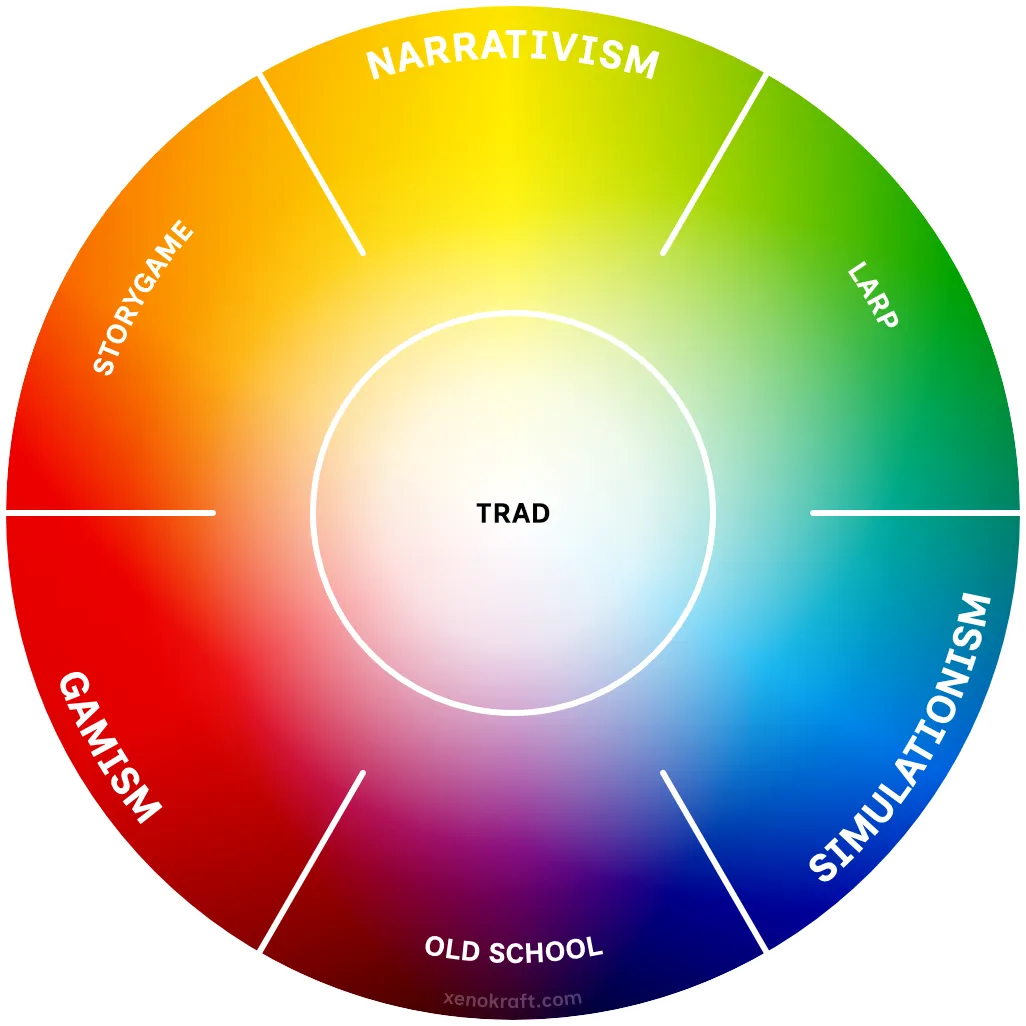
I won't make you wait for the pretty picture. Here it is! But keep reading to see how we got there.
The enduring legacy of GNS
This all started because I've been cataloguing my RPG collection recently and thinking about (and struggling with) the question of how to sort and group systems. I was aware of various threefold taxonomies like GDS, but I was having a hard time conceptualizing the blending of styles within and between games. My breakthrough came thanks to my kid's art homework, which inspired this visual model. It uses colour theory to attempt to capture and represent the universe of RPG play styles.
To be clear, this is essentially a re-interpretation of the existing GNS theory, which has been variously defended, debated and debunked over the past few decades. And yet, GNS endures in RPG spaces because it taps into an intuitive understanding of the different fundamental experiences that RPGs can elicit. So that's what we're starting with.
For reference, GNS suggests that there are three paradigms for RPG play: gamism, narrativism and simulationism. For me, the clearest way to differentiate them is to think about the proverbial bridge troll.
- Gamism asks: What challenge does the troll introduce? How can it be fairly overcome?
- Narrativism asks: What dramatic conflict does the troll represent? How can it be resolved to reach a satisfying conclusion?
- Simulationism asks: Why is the troll there? How would it reasonably behave in the context of the game world?
The outcome in every case might be "we fight the troll," but the mindset in each is very different. Are we playing a game that we can win? Are we trying to tell a good story? Are we immersing ourselves in a believable fictional world? Those are big philosophical and practical differences, and—crucially for our purposes—the RPG system you're using is going to have a lot to say about which questions you should be asking.
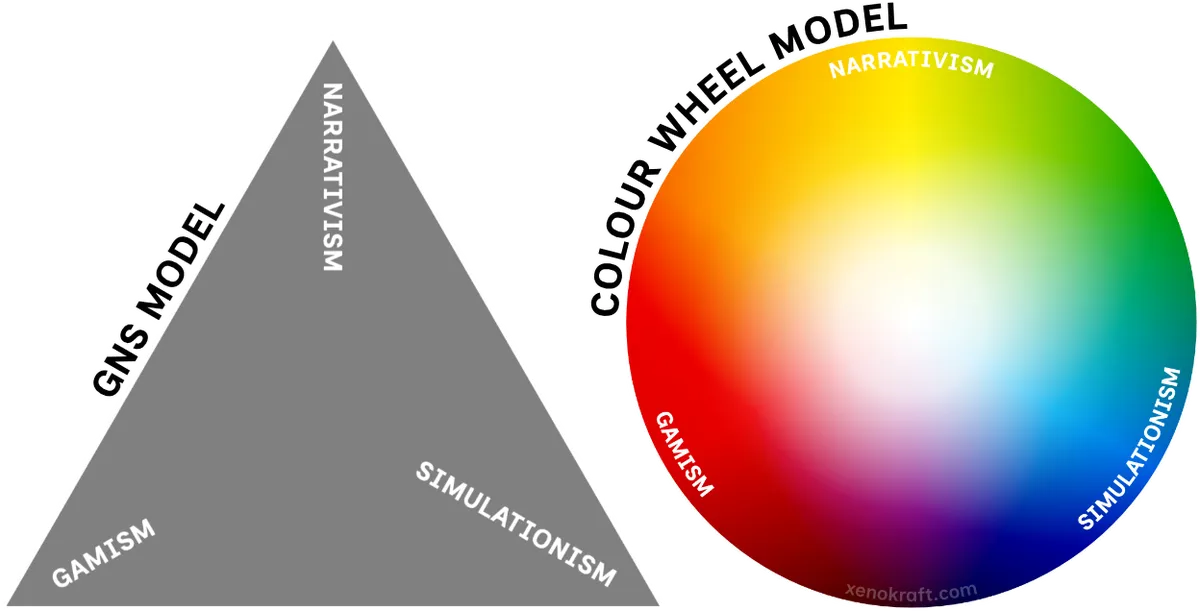
GNS has often been represented as a triangle, with each of the three categories at one of its points. Every RPG should fall somewhere in the triangle, in theory, depending on how strongly it leans into each dimension. What we're doing with the colour wheel model is similar, but in addition to changing the shape we're also using the complete colour spectrum, which besides being very pretty has some interesting implications.
Hue and saturation
In the colour wheel model, every RPG system has a particular mix of gamism (red), narrativism (yellow) and simulationism (blue), which produces a specific hue. I'm using primary colours for aesthetic reasons, but, for the nerds, we're actually modeling additive colour here, like the RGB spectrum.
Each system also has a saturation, which reflects the intensity with which the game leans into one or more of these categories at the expense of others. Closer to the middle of the wheel is less saturated, which means a system is an indistinct blend of paradigms. Further away from the middle is increasingly saturated, which means a system is distinctly some things and distinctly not others.
In the colour wheel model, rather than being given a discrete label, every RPG system has a unique colour that encompasses its hue and saturation.
Putting it into practice
Now, the easy part (j/k it's been the hard part for decades): plotting RPG systems on our colour wheel. We need to look at each game and give it a G, N and S score from 1 to 10 to determine its hue and saturation. This is, unfortunately, a minefield of subjectivity, which is one of the biggest critiques of GNS theory. But let's give it a shot anyway with a few touchstone systems.
(Obligatory caveat that, yes, any RPG system can in theory support any style of play, so what we're talking about here is the intended or inferred play style that a system supports.)
D&D 5e is the 900-pound gorilla in the room and a helpful starting point. It is famously an all-things-to-all-people system that checks all the GNS boxes. While many of the game's actual mechanics lean gamist and (to a lesser extent) simulationist, the intended play style (revealed especially through published adventures) leans narrativist. Let's give 5e scores of 6, 6 and 5 across G, N and S, respectively.
In our model, those colours mostly cancel each other out (as they would in the RGB spectrum) and we're left close to the middle of our circle with a yellow-tinged white. D&D 5e is beige, in other words, or perhaps vanilla. And that's a good thing! That's what it wants to be! It's the benchmark against which all other systems are compared.
In contrast, Pathfinder is decidedly gamist. It still has the trappings of its D&D forebears, but they are de-emphasized. Let's give Pathfinder scores of 9, 4 and 5 across G, N and S. When we plot that on our chart, Pathfinder ends up in the red with a delightful hint of pink. Let's call it cherry.
On the other side of the map we have a game like Alice is Missing. Heavily narrativist on its face and basically devoid of challenge mechanics, yet it is also simulationist. Not in the sense that you are mechanically modeling the world, but in that you are immersing yourself fully in that world and directly simulating the relationships between characters. I score Alice is Missing as a 2, 9 and 7. That gives it a lovely lime green colour.
And so on and so on. After repeating that process with a bunch more systems, here's what it all looks like on the wheel.
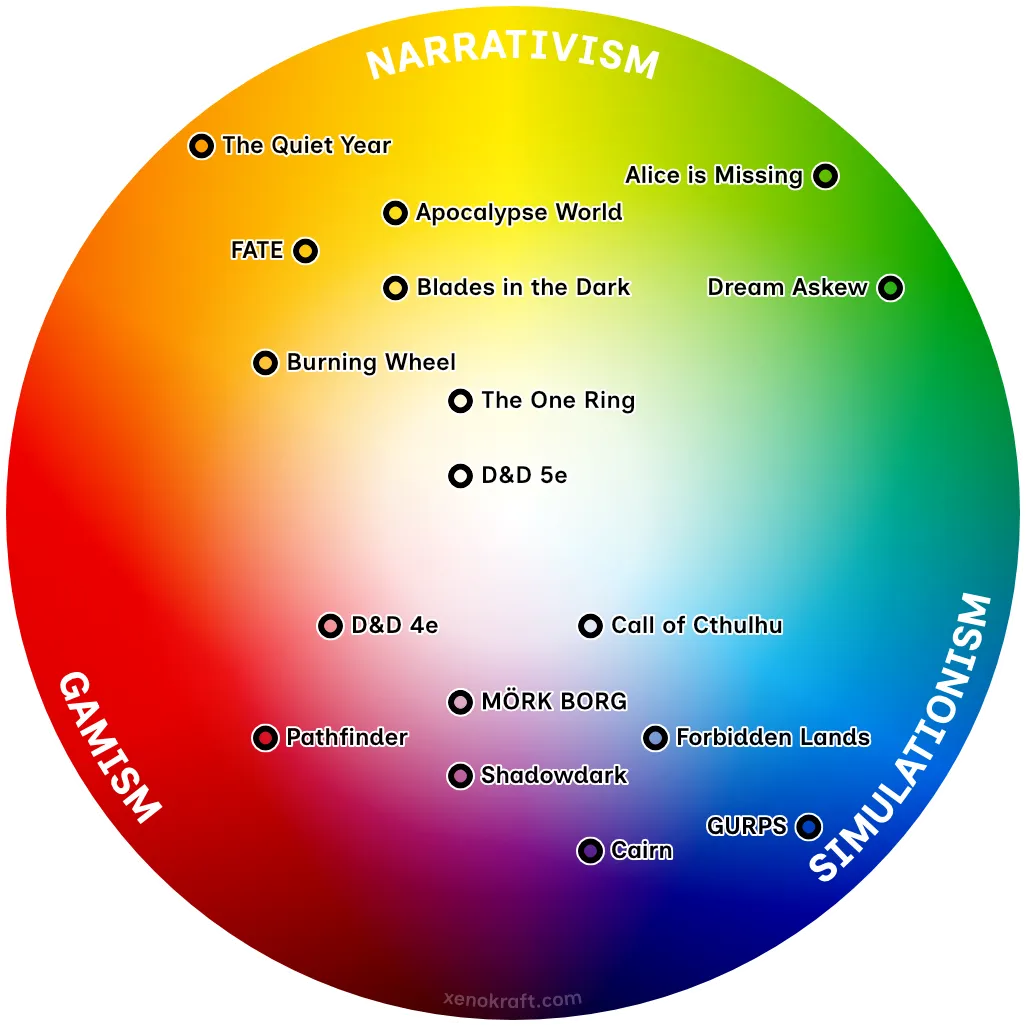
For reference, the numbers I used are summarized in the table below.
| System | Gamism | Narrativism | Simulationism | Coordinates | Colour |
|---|---|---|---|---|---|
| Alice is Missing | 2 | 9 | 7 | +7, +8 | Lime |
| Apocalypse World | 5 | 8 | 3 | –3, +7 | Sunflower |
| Blades in the Dark | 6 | 8 | 4 | –3, +5 | Banana |
| Burning Wheel | 8 | 8 | 4 | –6, +3 | Amber |
| Cairn | 7 | 3 | 8 | +1, –8 | Indigo |
| Call of Cthulhu | 6 | 5 | 7 | +1, –3 | Ice Blue |
| Dream Askew | 2 | 8 | 8 | +9, +5 | Emerald |
| Dungeons & Dragons (4e) | 7 | 4 | 4 | –4, –3 | Coral |
| Dungeons & Dragons (5e) | 6 | 6 | 5 | –1, +1 | Vanilla |
| FATE | 6 | 8 | 3 | –4, +6 | Goldenrod |
| Forbidden Lands | 7 | 5 | 9 | +3, –5 | Cornflower |
| GURPS | 6 | 3 | 9 | +4, –8 | Royal Blue |
| MÖRK BORG | 7 | 4 | 6 | –1, –4 | Pink |
| Pathfinder | 9 | 4 | 5 | –6, –5 | Cherry |
| Shadowdark | 8 | 4 | 7 | –1, –6 | Magenta |
| The One Ring | 5 | 6 | 4 | –1, +3 | Cream |
| The Quiet Year | 5 | 9 | 3 | –3, +8 | Tangerine |
The coordinates are relative to the centre of the wheel (0, 0), and they are calculated by plotting the three GNS dimensions for each system on the wheel and then finding the middle point of the triangle (trigonometry, baby!). I've used whole numbers from –10 to +10 for legibility.
I tried to include a diverse set of RPGs here to cover as much of the wheel as I could, but it still reflects my own biases both in terms of game selection (full disclosure: I've played most but not all of them) and in terms of the actual scoring (developing a rigorous, transparent methodology is a quixotic task for another day).
Everyone reading this knows deeply—perhaps irrepressibly—that at least one of these points is in the completely wrong spot. That's probably inevitable since every RPG experience is unique. But it would be fascinating to do a big survey of people who have played these games to find out where the consensus lies.
Identifying play style clusters
GNS theory is not the only taxonomy ever proposed for RPG systems and play styles. Another prominent pseudoscientific approach—equally defended, debated and debunked—are the Six Cultures of Play. Interestingly, most of those cultures map pretty cleanly onto our colour wheel.
In my interpretation, at least, we have:
- Trad (and neo-trad/OC) games in the desaturated middle,
- Old school (OSR) style games in the purple of gamism/simulationism,
- LARP (or, more accurately, Nordic LARP-adjacent) games in the green of narrativism/simulationism, and
- Storygames in the yellow-orange of gamist-tinged narrativism.
Perhaps the clearest theoretical contribution of this unified model of probably-bullshit RPG taxonomies is that play styles are defined as much by what they exclude as what they include. Yes, the OSR leans into gamism and simulationism, but the reason it is so deeply saturated on the colour wheel is that it actively rejects narrativism. Conversely, story games are defined not only by their narrativist mechanics but by their explicit rejection of simulationism.
Earlier, I said that each system in the colour wheel model has a unique colour rather than a discrete label. Let's go ahead and immediately break that rule by drawing some lines on the wheel to create boundaries between different categories of systems.
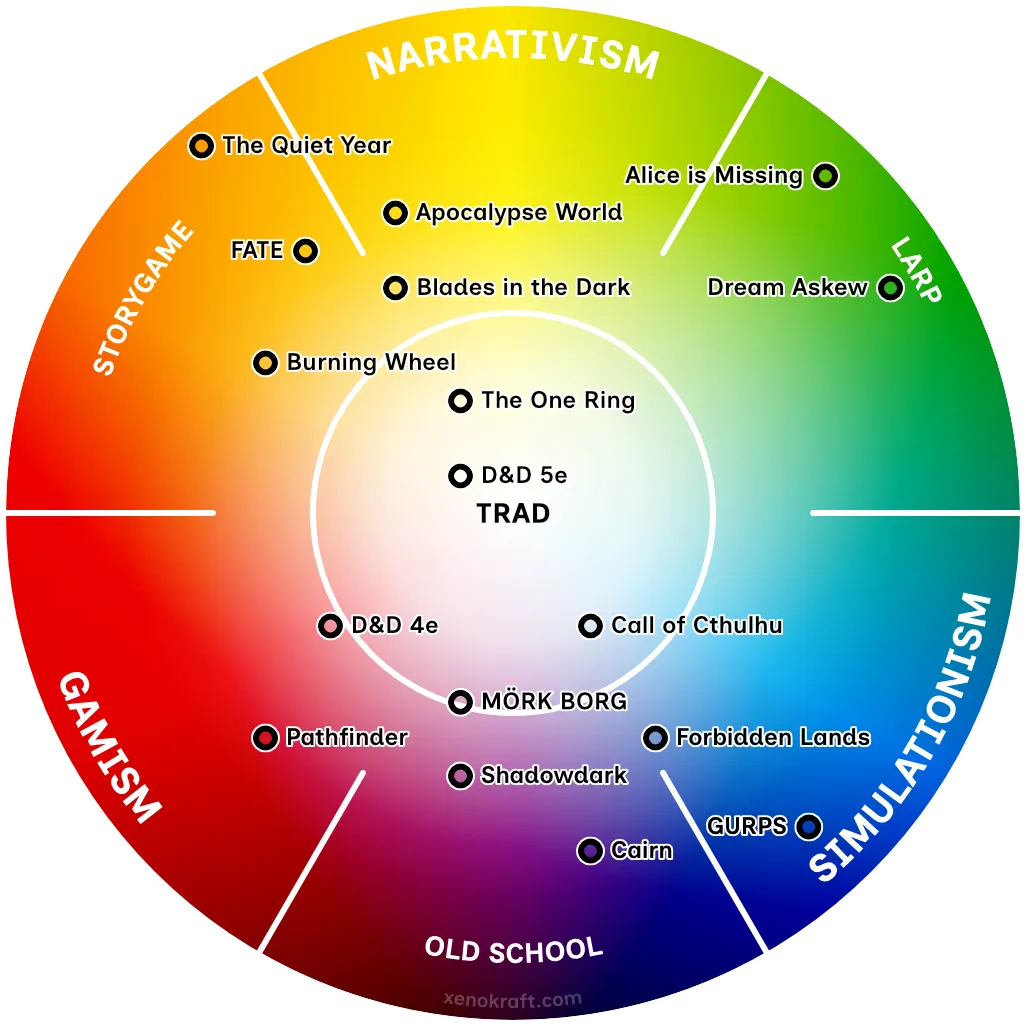
What's most interesting about this exercise is how systems tend to cluster on the borders between categories. It's rare to find RPGs that are purely gamist (that would be a board game), narrativist (that would be improv theatre) or simulationist (that would be, I dunno, economic modeling). Instead, RPGs tend to have a primary and secondary dimension, which is probably why discrete taxonomies have so often failed to reflect the nuances of most RPG systems.
For example, while MÖRK BORG, Shadowdark and Cairn are all ostensibly OSR systems, they are distinctly pink, magenta and indigo on our wheel. In fact, MÖRK BORG is on the border with trad, thanks to its smattering of narrative-first mechanics such as Omens and its de-emphasis on OSR-style simulationism. These games share DNA, but they don't support identical cultures of play.
How to use the colour wheel model
How is this useful then? To the extent that any RPG taxonomies are useful, they help us talk about the kinds of RPG experiences we value so that we can find the right games to play and people to play them with. What the colour wheel model offers is a more nuanced vocabulary for having those conversations.
I would call myself a blueberry kind of guy these days, with Forbidden Lands offering the closest approximation to my ideal RPG, but I have my lime and tangerine moods, too—a fruit salad of RPG preferences, if you will.
The language of saturation is also useful. A saturated game is opinionated about its intended play style, and that's something I value. I am less interested these days in RPGs that try to do a bit of everything. I want bold, rich colours in my RPG fruit salad, not vanilla yogurt.
But one person's vanilla yogurt is another person's blank canvas. The paper-white of trad RPGs is precisely what some (maybe most!) people are looking for, and it's helpful to see how that's reflected in the model.
Anyway, if nothing else, this model gave me a nice colour scheme for my RPG catalogue and a good idea for a snack. I hope it brings a little colour into your day, too.