The colour wheel model revisited: this time with objectivity
My first attempt at armchair RPG taxonomy went over so poorly that I am left with no choice but to retire from the armchair theorizing game.
Alas, I am too young—and have too recently started this blog in earnest—to retire from the theorizing game entirely. So I must instead shed the "armchair" designation and don the mantle of a full-blown RPG philosophizer and scientist. Onward!
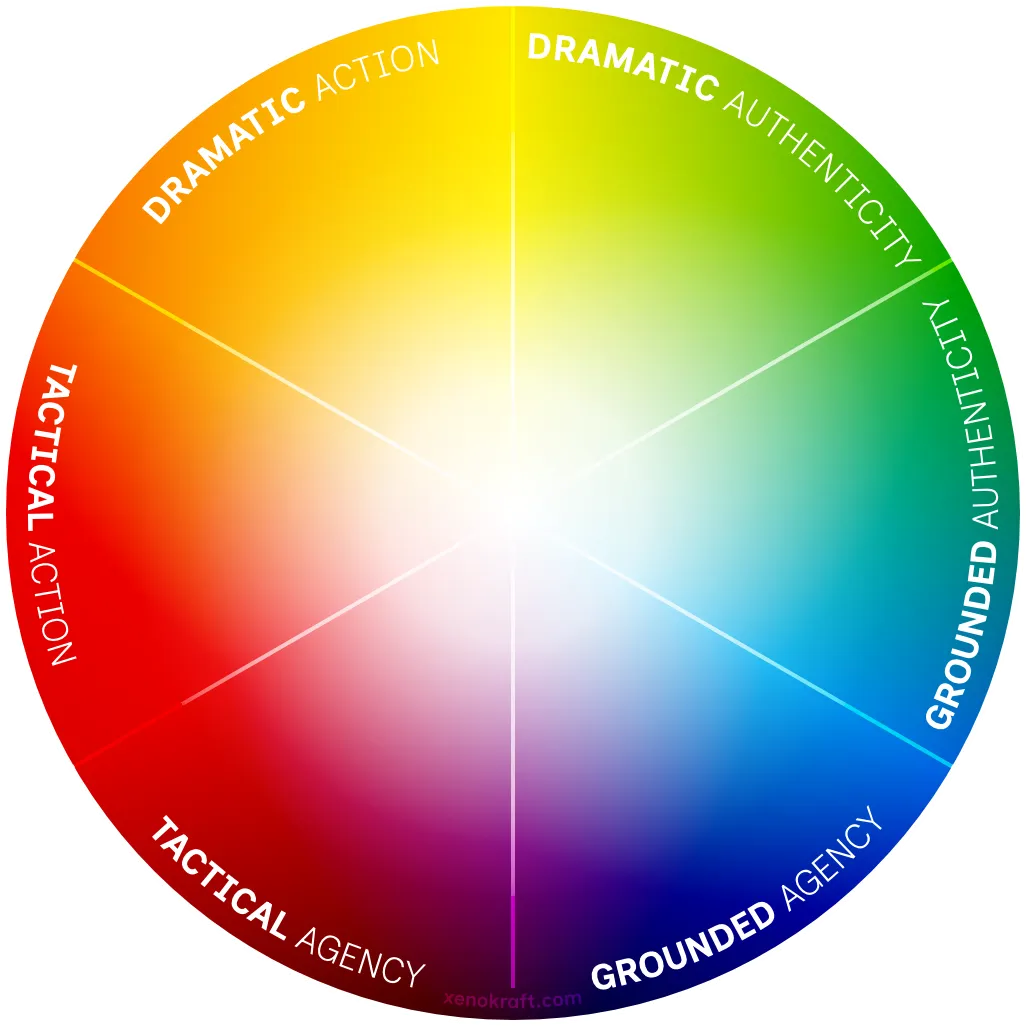
As before, I'll show you where we landed and then explain how we got there.
The haters have some good points
There were three big concerns raised with the initial colour wheel:
- It invoked GNS theory but didn't strictly adhere to it, which put off both critics and defenders of that weather-worn model.
- The placement of RPGs on the wheel was seen as (a) inaccurate and (b) arbitrary. As one astute commentator remarked, "source: trust me bro" does not a defensible model make.
- RPG taxonomies are something that only "sweaty dorks" care about.
All three criticisms are essentially correct, but I'm just going to ignore that last one.
In response to the first two, I have taken pains to produce a more transparent methodology for organizing RPG systems. That doesn't necessarily bring us any closer to being "correct" or "useful," but it does at least address the charge of arbitrariness by bringing us closer to the scientific ideal of "reproduceable."
In so doing, I have also validated many of the criticisms around specific system placement. 5e may not be so vanilla after all!
Goodbye GNS, hello TDG
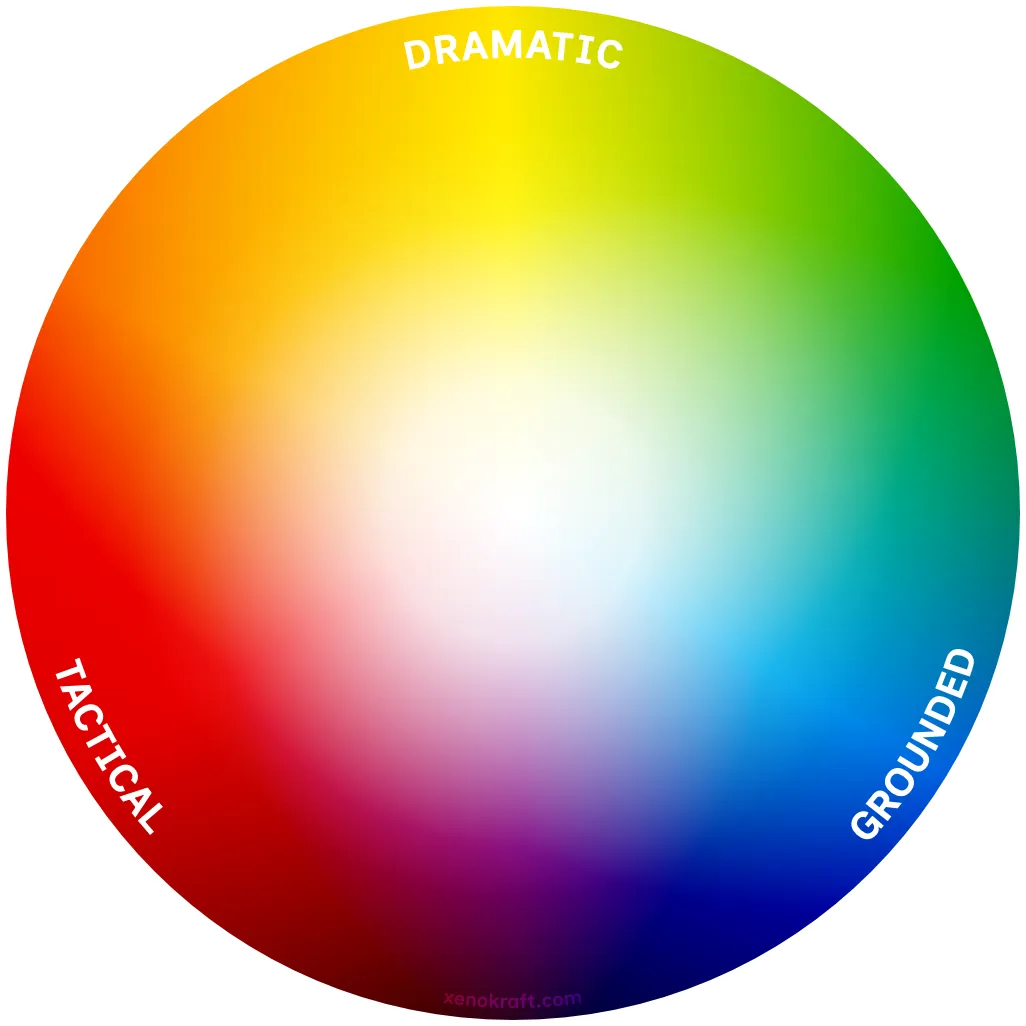
First off, we're changing the basic categories. Instead of gamism, narrativism and simulationism, we're going with tactical, dramatic and grounded as the three main poles of our wheel.
This is not merely a rebranding exercise. Instead of nouns to describe discrete player agendas, we are using adjectives to describe degrees of system support. Whereas GNS (in its original formulation, at least) views each agenda as mutually exclusive, it is perfectly reasonable to describe an RPG as having different systems that support tactical, dramatic and grounded play experiences. Here are our working definitions:
🟥 Tactical systems support meaningful decision making in pursuit of a goal. They tend to be abstract in nature (hit points, dice modifiers, etc.), which enables concrete win/loss conditions, often at the expense of storytelling or realism/verisimilitude.
🟨 Dramatic systems support the telling of satisfying stories. They tend to foreground authorial control and qualitative mechanics (metacurrencies, milestone progression, etc.). This definition is inclusive of both emergent drama (player authorship) and linear narratives (GM authorship), both of which prioritize the end result—a good story—over tactical optimization or world fidelity.
🟦 Grounded systems support the illusion of inhabiting a believable, living world. They tend to emphasize diegesis and simulation (skill-based progression, random weather, etc.), which is to say they prioritize internal consistency over storytelling or strategic decision making. This definition is inclusive of systems that support player immersion, which, though very different from mechanical simulationism on paper, also delivers a grounded play experience—that feeling of being a real person in a real place (even a fictional one).
I should say that "system" here is broader than just mechanics. We are considering, for example, the role of the GM vis-à-vis the players, and the default structure of a campaign. Anything in the rulebook that shapes the play experience is fair game. But we are remaining focused on what that rulebook offers, even if people often take those rules in wildly different directions.
Incidentally, this brings us more in line with Sam Sorensen's Three-Question Taxonomy, which in retrospect would have been a better place to start than GNS. It's not the exact same, but Sam's focus on problem-solving, authorship and world precedence roughly maps to our tactical, dramatic and grounded, respectively.
A 100% empirical, no-nonsense rubric for classifying RPG systems
...is still impossible, but we're going to at least take a step in that direction.
Here I propose a 20-question test for classifying RPG systems. A spiritual expansion on Sam's three questions, perhaps. The 20 questions are not necessarily meant to be comprehensive, but rather a proxy for particular play experiences. Whether or not an RPG has overland travel mechanics, for example, is a specific measure that is assumed to correlate with a more generally grounded play experience.
Each question is multiple choice, and each answer provides a certain number of points in tactical, dramatic and/or grounded. Add them all up and you get a TDG profile for each system, which we can then plot on our colour wheel.
To be clear, there is still plenty of subjectivity here, both in the questions and in the answers. Do metacurrencies lean more tactical or dramatic? And is something like 5e Inspiration an "essential" metacurrency or merely an "incidental" one? There aren't always clear-cut answers, but by subjecting every RPG to the same transparent methodology we can at least get a sense of where systems fall relative to each other. If we later decide that metacurrencies should be more heavily weighted toward the dramatic pole, for example, then every system with a metacurrency will shift by the same amount.
Here is the rubric. Note that for every question the answer may be "none of the above," which provides no points.
💡 1. What is the player's primary perspective?
∘ Internal / actor (–1 T, +1 D, +2 G)
∘ External / puppeteer (+1 T, +1 D)
∘ Meta / author (–1 T, +2 D, –1 G)
💡 2. How is the GM's role framed?
∘ Director / storyteller (+2 D, –1 G)
∘ Referee / arbiter (+1 T, –1 D, +1 G)
∘ Director + referee (+1 T, +1 D)
💡 3. What is the primary challenge?
∘ Character optimization (+1 T, +1 D)
∘ Problem solving (+1 T, +1 G)
∘ Genre emulation (+2 D, –1 G)
∘ Subjective expression (–1 T, +1 D, +2 G)
💡 4. How are intraparty relationships treated?
∘ Source of conflict (+1 D, +1 G)
∘ Party roles / mechanical (+1 T)
∘ Diegetic / flavour (+1 D)
🎲 5. How is core action resolution handled?
∘ Degrees of success (+1 T, +1 G)
∘ Binary pass/fail (+1 T)
∘ Fail forward (+1 D)
∘ Creative prompts (–1 T, +2 D, +1 G)
🎲 6. How complex is core action resolution?
∘ Subsystems / multi-step / math (+2 T, –1 D)
∘ Pools / pushing / negotiation (+1 T, +1 D)
∘ Universal / single step (+1 T)
🎲 7. What role do metacurrencies play?
∘ Essential / authorial (+1 T, +2 D, –1 G)
∘ Incidental / modifiers (+1 T, +1 D)
♟️ 8. What is the default process for PC creation?
∘ Custom build / mostly mechanics (+2 T)
∘ Quick build / mostly flavour (+1 T, +1 D)
∘ Randomized (–1 D, +1 G)
∘ Pre-generated (+2 D)
♟️ 9. How many numerical attributes/skills does a PC have?
∘ 25+ (+1 T, –1 D, +2 G)
∘ 7 to 24 (+2 T, +1 G)
∘ 1 to 6 (+1 T)
♟️ 10. What qualitative features does a PC have?
∘ Essential / mechanical (+1 T, +2 D)
∘ Incidental / flavour (+1 D)
♟️ 11. How do PCs earn progression?
∘ Combat / treasure (+2 T)
∘ Milestones / achievements (+1 T, +2 D, –1 G)
∘ Diegetic / action resolution (+2 G)
♟️ 12. How is PC advancement handled?
∘ Discrete / levels (+1 T, +1 D, –1 G)
∘ Continuous / skills (+1 T, +1 G)
📐 13. How is inventory managed?
∘ Specific / weights (+1 T, –1 D, +2 G)
∘ Approximate / slots (+1 T, +1 G)
∘ Abstract / freeform (+1 D)
📐 14. How is space represented in encounters?
∘ Specific / measurements / grid (+1 T, –1 D, +2 G)
∘ Approximate / zones (+1 T, +1 G)
📐 15. How is time represented during play?
∘ Real-time (+2 G)
∘ Structured / dungeon turns / watches (+1 T, –1 D, +1 G)
∘ Situational / initiative order (+1 T)
∘ Abstract / scenes (+1 D)
📐 16. How is overland travel handled?
∘ Specific / measurements (+2 G)
∘ Approximate / grids / hex crawl (+1 T, +1 G)
∘ Abstract / point-to-point (+1 T, +1 D)
📐 17. How is damage and injury handled?
∘ Abstract / hit points (+2 T, –1 G)
∘ Diegetic / stat loss (+1 T, +2 G)
∘ Narrative / stress / trauma (+1 D, +1 G)
🌐 18. What is the default game structure?
∘ Co-authorship / narrative (–1 T, +2 D, –1 G)
∘ Linear / adventure module (+1 T, +1 D)
∘ Capsule / setting sandbox (+1 D, +1 G)
∘ Open world / dungeon crawl / procedural sandbox (+1 T, –1 D, +2 G)
🌐 19. What is the default encounter design?
∘ Balanced (+2 T, +1 D)
∘ Randomized (+1 T, +1 G)
∘ Diegetic / incidental (+1 D, +1 G)
🌐 20. How are faction dynamics handled?
∘ Procedural (+1 T, +2 G)
∘ Diegetic / incidental (+1 D)
Sending RPG systems to school
In the interest of RPG science, I subjected 23 different RPGs to this test. They were a rowdy bunch. MÖRK BORG ate its pencil, Honey Heist ransacked the snack table and Monsterhearts had a meltdown. But in the end we got scores for every system.
Complete results are available in this spreadsheet (which includes all the formulas, so you can make a copy and mess around with it). I'm not an expert in every one of these systems, so consider it a midterm rather than a final exam.
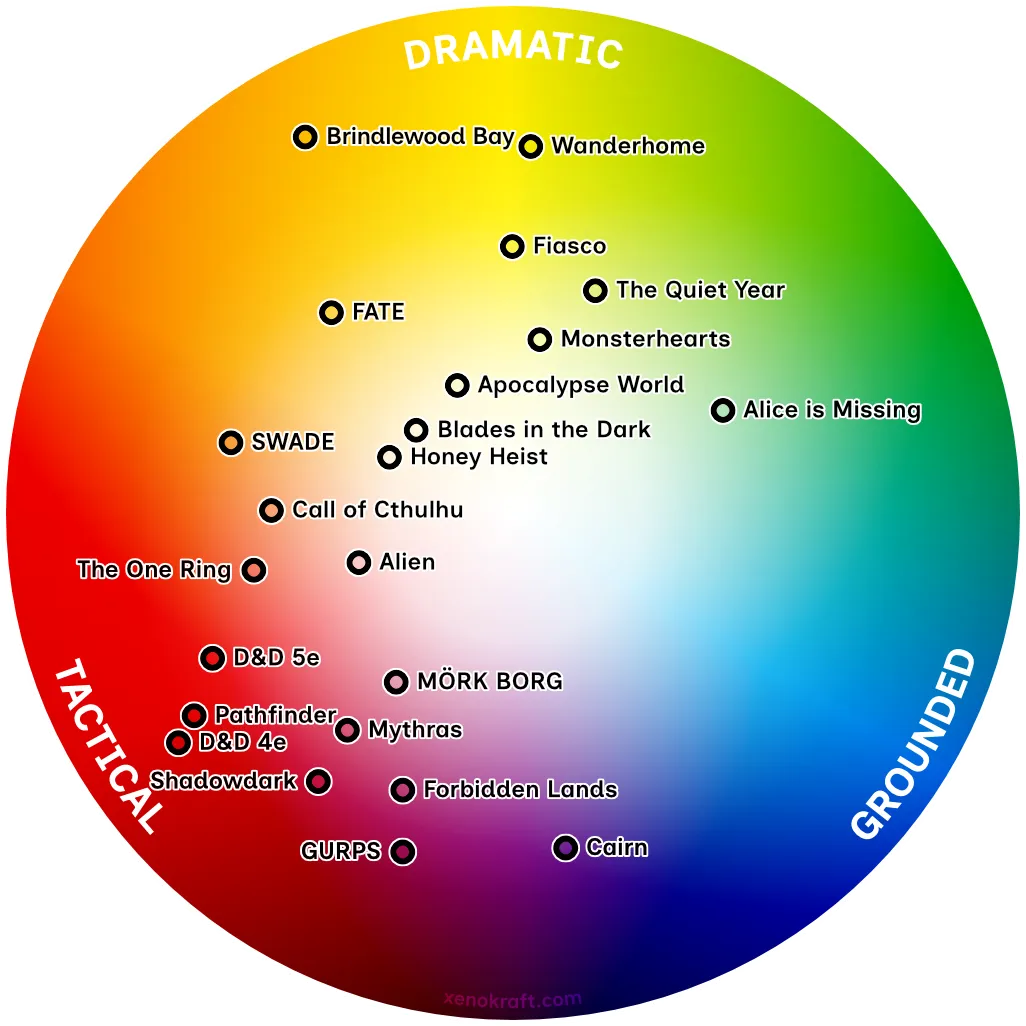
Here's what the results look like plotted on our colour wheel.
Red in the face
The first time I threw darts at the colour wheel, it told a simple and intuitive story about trad games being in the washed out middle with more opinionated games radiating outward toward the colourful perimeter. That's not what we find here at all.
Based on our 20-question test, the entire D&D family is unambiguously in the bloody red of the tactical spectrum. Just because people play 5e as a LARP does not change the fact that a dart weighs 1/4 lbs and an Owlbear has 59 hit points. Moreover, while wars have been waged over the differences between 5e, 4e, Pathfinder and their ilk—and indeed there are real differences between them—these games still have vastly more in common with one another than they do other RPGs.
Of the games in this survey, the one that falls closest to the desaturated middle is Blades in the Dark. It strike a clear balance between story-forward mechanics, gamified decision-making and a grounded, dynamic world. Alien and Apocalypse World are in the same ballpark. As is Honey Heist, but mainly because, as a one-page RPG, it lacks support in every direction rather than providing a balance of systems.
In terms of outliers, we have Brindlewood Bay up in the orange (explicitly storytelling), Alice is Missing off in the seafoam (practically LARP) and then Cairn down in the violet (deeply grounded).
Cairn is a really interesting case, because it is even more "grounded" in our model than the famously-dense GURPS. That's not because Cairn is more simulationist. It's because Cairn has stripped away so much of the tactical legacy of trad games—and so explicitly rejected storytelling as a gameplay principle—that what remains is a rules framework ruthlessly committed to diegetic play. GURPS includes a lot of tactical abstractions and even a few dramatic elements, such as Character Point progression. In contrast, PC progression in Cairn is driven by "the logical result of a character’s actions" without the abstraction of an XP or level system whatsoever.
Is this useful yet?
While this iteration of the colour wheel is more objective than the previous one, that doesn't mean it's accurate. And it's still not clear how useful this whole enterprise is to begin with.
One of the most notable conclusions looking at this chart is that familiar labels like "trad", "OSR" and "storygame" are even less descriptive than I previously thought. Where would you even draw those circles on the wheel? Does GURPS really have more in common with Cairn than it does with D&D? Are Savage Worlds and FATE in the same pulpy box, or are they on either side of the trad/narrative boundary? Etcetera.
Partly, that's a function of our oversimplified three-part TDG model. By lumping simulationism and immersion into the "grounded" bucket, we conflate very different mechanical and tonal approaches. And by lumping GM authorship and player authorship into "dramatic," we push together systems that have very different design goals. But more fundamentally it reflects the fact that every RPG is a unique blend of systems that support multiple, sometimes contradictory play experiences.
The big takeaway here might just be that RPG taxonomy doesn't work very well. Which is what everyone keeps telling me. But sometimes you just need to learn these things for yourself.
And yet I can't help but look for patterns here. What is it that unifies games that cluster together on the wheel but otherwise appear different?
The AAAs of TDG RPGs
One interpretation, I posit, is core values. There are three of them. And they are all auspiciously alliterative.
🟧 Action covers the space between tactical and dramatic (the inverse of grounded). These games value excitement, dice rolling and larger-than-life characters. You've got pulp, cinema, comedy. It may or may not involve fighting and danger. The important thing is that stuff is happening and the players are having a good time.
🟩 Authenticity blends dramatic and grounded (the inverse of tactical). These are games that value creative and emotional expression. You've got messy character dramas, poignant worldbuilders, slice-of-life fantasies. They are all about the genuine feels. This is the emotional bleed risk zone.
🟪 Agency lives between tactical and grounded (the inverse of dramatic). These games value problem solving with player skill and the real consequences that follow. You've got wargames, old school dungeon crawlers, open world sandboxes. The key unifier is that player choices matter.
Since the AAAs are offset from the TDGs, we end up with six discrete categories into which our systems can be sorted. FATE becomes a Dramatic/Action game, Shadowdark is Tactical/Agency, Alice is Missing is Grounded/Authenticity, and so on. There are (inevitably) lots of games on the edges so the clean boundaries are a bit misleading, but you get the idea.
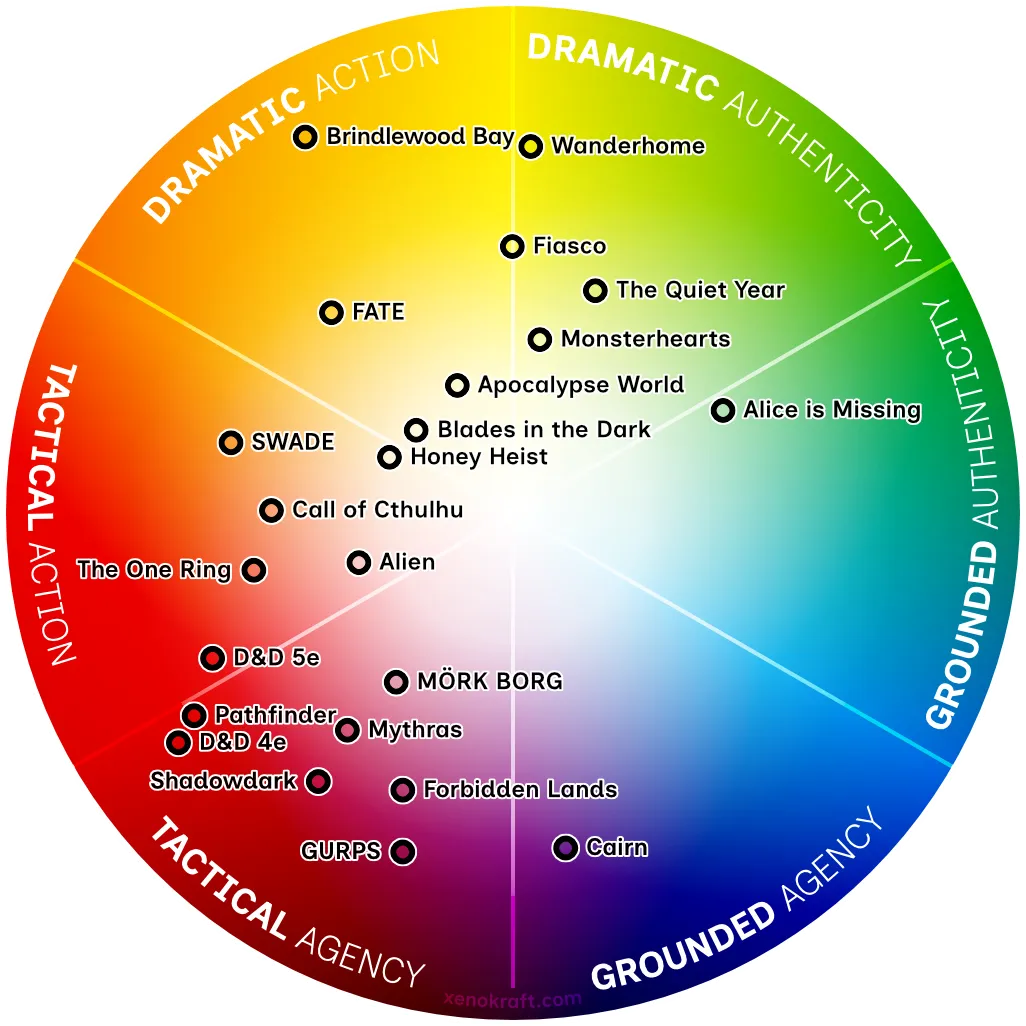
I remain confounded by the question of whether this is useful. I'm going to need to give this AAA formulation some more thought. But I do think we're getting closer to something here. I can see how it might help when assessing a new game to see whether it's in the same slice of the pie as games you already know and like. I'm sure readers will have some good suggestions for how to improve the 20-question rubric I proposed here, too.
At the end of the day, an RPG system is only one factor in shaping the overall RPG experience. How you run games, and who you play with, will always matter more. And that's probably what we should be focused on.
But taxonomy is still fun.